
Shopify vs Wix for eCommerce: Which Platform Is Better for Your Online Store?

Updated: Aug 10

Shopify vs Wix: Quick Summary
If you are comparing Shopify vs Wix, you are probably trying to work out which platform is better for selling online.
The short answer is that both can work, but they are built with different priorities.
Shopify is a dedicated ecommerce platform. It is designed for businesses that want to sell products online, manage inventory, process orders, connect apps, run promotions and scale an online store over time.
Wix is a website builder with ecommerce features. It is usually better suited to small businesses that want a beautiful, flexible website with the option to sell products, take bookings, publish content or manage enquiries from the same place.
The better choice depends on how central ecommerce is to your business.
If your website is mainly an online store, Shopify is usually the stronger option. If your website needs to combine services, content, brand storytelling and a smaller shop, Wix may be the better fit.
Key Takeaways
|
Shopify vs Wix: Quick Comparison
Area | Shopify | Wix |
Best for | Ecommerce-first businesses and growing online stores. | Small stores, brand-led websites and businesses that also sell online. |
Ease of use | Easy to manage products and orders, but more ecommerce-focused. | Easier for general website editing and visual content updates. |
Design flexibility | Strong ecommerce themes, but more structured around store layouts. | More flexible for custom website sections, service pages and brand storytelling. |
Checkout | Strong, dedicated ecommerce checkout built for online selling. | Suitable for smaller stores, but generally less ecommerce-specialised. |
Apps | Larger ecommerce-focused app ecosystem. | App market supports ecommerce and broader website features. |
SEO | Strong ecommerce SEO potential for product, collection and blog content. | Good SEO control for small stores and content-led websites. |
Scalability | Better for larger product ranges, multichannel selling and store growth. | Better for simpler stores or websites where selling is secondary. |
Cost | Can become more expensive with apps, themes and advanced features. | Can be more cost-effective for smaller stores, depending on needs. |
Best fit | Businesses that rely on ecommerce revenue. | Businesses that need a website first and store second. |
What Is Shopify?
Shopify is a dedicated ecommerce platform built for selling products online.
It is designed to help businesses manage products, inventory, payments, checkout, shipping, discounts, sales channels, customer accounts, analytics and more from one ecommerce-focused system.
Shopify can work well for:
Ecommerce-first businesses
Product-based brands
Fashion, beauty, food, lifestyle and retail stores
Businesses with growing product ranges
Stores that need stronger checkout and order management
Businesses selling across multiple channels
Brands that want apps for reviews, subscriptions, bundles, upsells or shipping
Stores that plan to scale over time
The main benefit of Shopify is that ecommerce is not an add-on. It is the centre of the platform.
Shopify’s own pricing and product information is structured around ecommerce plans, sales tools and store growth, which reflects the platform’s focus on online selling. You can review the current inclusions on Shopify’s Australian pricing page.
What Is Wix eCommerce?
Wix eCommerce allows businesses to add online store functionality to a Wix website.
It can support product pages, online payments, store management, shipping, coupons, abandoned cart tools, automations, marketing features and content-rich website pages.
Wix can work well for:
Small online stores
Service businesses that also sell products
Creative brands
Personal brands
Event, workshop or booking-based businesses
Businesses with a smaller product range
Brands that need strong visual design and storytelling
Websites that combine services, content, enquiries and ecommerce
The main benefit of Wix is flexibility.
It lets you build a website that can include ecommerce, but is not limited to ecommerce. That can be useful if your business needs service pages, blogs, bookings, landing pages, portfolios or brand-led content alongside a shop.
Wix positions its ecommerce platform as an all-in-one ecommerce website builder with customisable storefronts, AI-assisted creation, product management and business tools. You can explore the current features on the official Wix eCommerce page.
Checkout: Shopify Is Usually Stronger
Checkout is one of the biggest differences between Shopify and Wix.
If your business relies on online sales, checkout experience matters. A clear, reliable checkout can affect trust, conversion rates and how easy it is for customers to complete their purchase.
Shopify is usually stronger for ecommerce checkout because the platform is built around selling from the start.
Shopify is generally better suited to:
Higher sales volumes
Larger product ranges
Discount codes and promotions
Abandoned cart strategies
Multiple payment options
Customer accounts
Shipping and fulfilment workflows
More advanced ecommerce reporting
Stores that need room to scale

Wix checkout can still work well for smaller stores, especially where ecommerce is not the main part of the business.

But if checkout, conversion, orders and product management are central to the business, Shopify is usually the stronger choice.
Apps and Integrations: Shopify Has the Ecommerce Edge
Apps can make a big difference to how an ecommerce store grows.
Shopify has one of the strongest ecommerce app ecosystems, with apps for product reviews, email marketing, subscriptions, shipping, fulfilment, SEO, upsells, bundles, loyalty programs, inventory and more.
The Shopify App Store is built around extending online stores, which makes Shopify especially useful for businesses that need more advanced ecommerce functionality over time.
Wix also has apps and built-in business tools, but it is not as ecommerce-specialised as Shopify.
Wix may be enough if you need:
A simple online shop
Forms and enquiries
Bookings
Basic automations
Email marketing
Coupons
Simple product management
Blog or content pages
Shopify is usually the better fit if ecommerce features are likely to become more complex as the business grows.
Design Flexibility: Wix Is Often Easier for Brand-Led Websites
Wix is often stronger when the website needs to feel more flexible, visual or content-led.

This matters for businesses where the website needs to do more than display products.
For example, Wix may be a good fit if you need:
Service pages
About pages with strong brand storytelling
Landing pages
Blog content
Portfolio or gallery pages
Booking pages
Event pages
Flexible page layouts
More visual control without code
Shopify themes can look professional, but they are generally more structured around ecommerce layouts such as products, collections, carts and checkout.
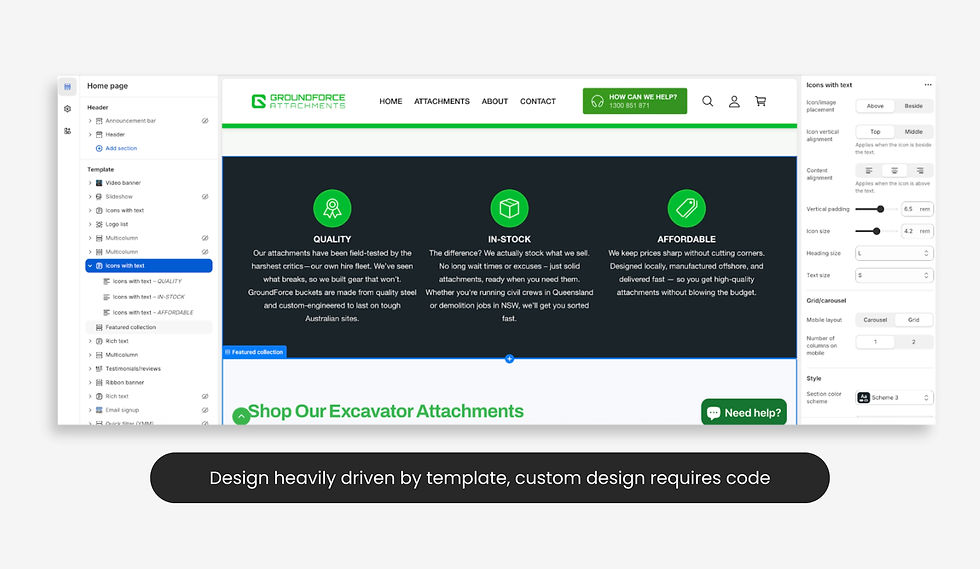
This is useful for online stores, but it may feel less flexible if the website needs to combine ecommerce with service-based content, brand storytelling or custom page layouts.
Independent ecommerce comparisons often reflect this difference. For example, Website Builder Expert’s Wix vs Shopify comparison reviews both platforms across areas such as sales features, design, support, functionality, pricing and user experience, which is helpful when weighing up ecommerce power against design flexibility.
SEO: Both Can Work, but Structure Matters
SEO can work on both Shopify and Wix.
The platform alone will not guarantee visibility, traffic or sales. What matters is how the website is structured, written, optimised and maintained.
For ecommerce SEO, you need to think about:
Product page titles and descriptions
Collection or category pages
Clean URLs
Internal links
Image alt text
Helpful product content
Blog or buying guide content
Mobile experience
Page speed
Structured data
Reviews and trust signals
Search-friendly navigation
Shopify is usually stronger for ecommerce SEO when you have a growing product range, product categories, collections, filters, apps and sales-focused content.
Wix can still work well for smaller stores, especially when the business also needs service pages, educational content, local SEO and more flexible page layouts.
For a deeper look at SEO foundations, read our guide on SEO Basics: What Small Businesses Need to Know.
If you are using Wix specifically, our guide on Wix SEO in Sydney: 15 Technical Setups That Move the Needle may also help.
GEO and AI Search: Your Store Still Needs Clear Content
As search becomes more AI-powered, ecommerce websites need to be easier for both people and search systems to understand.
This does not replace SEO. It builds on it.
Whether you use Shopify or Wix, your store should clearly explain:
What you sell
Who the products are for
What makes them different
Product features and benefits
Shipping, returns and delivery information
Common customer questions
Brand story and trust signals
Reviews, testimonials or social proof
For Shopify stores, this may mean stronger product pages, collection descriptions, FAQs, buying guides and review content.
For Wix stores, it may mean combining product pages with stronger brand storytelling, service pages, blog content and local relevance.
The goal is not just to have products online. The goal is to make your products, brand and buying experience easier to understand.
For more context, read our guide on Google Search Is Changing: What Google’s AI Updates Mean for Small Businesses.
Cost: Think Beyond the Monthly Plan
Cost is not just the monthly subscription.
With ecommerce platforms, the real cost can also include:
Paid themes
Apps and plugins
Payment processing fees
Transaction fees
Email marketing tools
Product review apps
Subscription apps
Shipping integrations
SEO tools
Developer or designer support
Ongoing updates and maintenance
Shopify can become more expensive as your store grows, especially if you rely on multiple apps or premium themes. However, those costs may be worthwhile if ecommerce is a major revenue channel.
Wix may be more cost-effective for smaller stores or businesses that need a broader website with some ecommerce functionality.
Because pricing and inclusions change often, it is best to check the current platform pricing directly before deciding. Start with Shopify’s Australian pricing page and Wix’s current pricing plans.
Which Platform Scales Better?
Shopify is usually the stronger platform for ecommerce growth.
It is better suited to businesses that plan to:
Add larger product ranges
Sell across multiple channels
Use more advanced shipping or fulfilment workflows
Add subscriptions, bundles or upsells
Manage product reviews
Run ecommerce-focused marketing
Use detailed sales analytics
Scale online sales as a major revenue stream
Wix can still grow with a small business, but it is usually better when ecommerce is part of the website rather than the entire business model.
If your online store is expected to become more complex over time, Shopify is usually the safer long-term choice.
If your store will stay simple and your website also needs strong service, content or brand pages, Wix may be more practical.
So, Should You Choose Shopify or Wix?
Choose Shopify if:
Ecommerce is the main purpose of the website
You have a growing product range
You need stronger checkout and order management
You want access to a large ecommerce app ecosystem
You plan to scale online sales
You need subscriptions, reviews, upsells or advanced shipping tools
You want a platform built specifically for selling online
Choose Wix if:
Ecommerce is only one part of your website
You have a smaller product range
You need more flexible content pages
You want easier visual editing
You sell services as well as products
You need bookings, blogs, forms or enquiries alongside your shop
You want a brand-led website that also sells products
The simplest way to think about it is:
Shopify is usually better for ecommerce-first businesses.
Wix is usually better for website-first businesses that also sell online.
If you are still comparing platform options, read our guide to the Best Website Builders for Small Businesses, where we compare Wix, Shopify, Squarespace, GoDaddy and WordPress.
Flow Cre8tive Recommendation
At Flow Cre8tive, we work with both Shopify and Wix, but we recommend them for different situations.
For ecommerce-first businesses, we usually recommend Shopify because it is built specifically for selling online. It gives product-based businesses stronger ecommerce tools, checkout, apps, store management and room to grow.
For businesses that need a flexible website with a smaller shop attached, we often recommend Wix. It can be easier to manage, more flexible for service pages and stronger for businesses that need content, bookings, enquiries or brand storytelling alongside ecommerce.
In simple terms:
Choose Shopify when the online store is the business.
Choose Wix when the website needs to support the business, and ecommerce is one part of that.
The right choice depends on your products, goals, budget, website structure and how much ecommerce needs to grow over time.
For example, we used Shopify for product-led brands like Mizzica Liqueur and Bear Bagels, where ecommerce, orders and product pathways were central to the website. For brand-led or content-rich stores like The Single Edit and Five O5, Wix allowed more flexibility around storytelling, product education and visual brand experience.
For a closer look at how different ecommerce platforms can work in real projects, you can explore our Website Project Portfolio.
Need Help Choosing Between Shopify and Wix?
Choosing between Shopify and Wix is not just about features.
It is about choosing the platform that best supports how your business sells, grows and manages its website over time.
If you are not sure whether Shopify, Wix or another platform is the right fit, Book a Discovery Call and we can talk through your website goals, ecommerce needs and the best next step.

Ready to Talk Through Options?
We can help you choose the best next step based on your goals, not generic platform advice.
Or, if you already have a website and are not sure whether it needs a redesign, SEO improvements or smaller updates first, start with a Website Audit. It will help uncover the gaps across design, content, SEO, user experience, trust signals and enquiry pathways before you invest in bigger changes.
Shopify vs Wix FAQs
Is Shopify better than Wix for ecommerce?
Shopify is usually better for ecommerce-first businesses because it is built specifically for online selling, checkout, inventory, product management, apps and store growth. Wix can still work well for smaller stores or businesses where ecommerce is only one part of the website.
Is Wix good for ecommerce?
Yes. Wix can be a good ecommerce option for small stores, creative brands and businesses that want a flexible website with some online selling functionality. It may be less suitable for larger or more complex ecommerce businesses that need advanced checkout, inventory, shipping, apps or scaling features.
Is Shopify harder to use than Wix?
Shopify is not necessarily hard to use, but it is more ecommerce-focused. Wix can feel easier for general website editing, visual layouts and content updates. Shopify may feel more structured because it is designed around products, collections, checkout and store management.
Which is better for SEO: Shopify or Wix?
Both Shopify and Wix can support SEO. Shopify is often stronger for ecommerce SEO because it is built around product and collection structures. Wix can work well for smaller stores and content-led websites if the SEO foundations are set up properly.
Which is cheaper: Shopify or Wix?
Wix may be more cost-effective for smaller stores, while Shopify can become more expensive once you add apps, themes and advanced ecommerce features. However, Shopify may offer better long-term value if ecommerce is a major revenue channel for your business.
Should I use Shopify or Wix for a small store?
For a simple store with a smaller product range, Wix may be enough. If you plan to grow the store, add more products, manage more orders or rely heavily on online sales, Shopify is usually the stronger long-term choice.
Can I move from Wix to Shopify later?
Yes, but it is usually treated as a migration and redesign rather than a simple switch. Moving from Wix to Shopify can be a good opportunity to improve product structure, SEO foundations, checkout, content, user experience and store strategy.
Is Shopify better than Wix for scaling?
Yes. Shopify is usually better for scaling ecommerce because it has stronger store management tools, apps, checkout, integrations and ecommerce-focused features. Wix can still scale for smaller businesses, but Shopify is usually the better choice for ecommerce growth.
Related Posts
If you are still comparing website platforms, these related guides may help:
Best Website Builder for Small Businesses: Wix, Shopify, Squarespace, GoDaddy or WordPress?
Wix vs GoDaddy for Small Businesses: Which Website Builder Is Better?
Wix Classic vs Wix Studio: What’s the Difference and Which One Does Your Business Actually Need?
Wix vs Squarespace: Which Website Builder Is Better for Small Businesses?
AI Website Builder vs Website Designer: Which Is Better for Your Business?


